Leading the Exploration of Agent Productization Paths
Empowering Digital Transformation in Manufacturing and Education Publishing
On August 15–16, 2025, the 2025 Global Product Manager Conference (PM-Summit), co-hosted by CSDN and Boolan, grandly opened at The Westin Beijing. As an annual event in product innovation, this year's conference brought together more than 40 frontline experts in internet and technology products worldwide, with over 1,000 attendees exploring AI product practice and future trends.
Tengyu Hu, co-founder and Chief Product Officer of SOIN AI, was invited to attend. In two important sessions — the panel forum on exploring agent productization paths and a keynote — he shared SOIN AI's hands-on deployment experience in Agentic AI toB scenarios, fully demonstrating the company's technical strength and innovation results.
Panel Forum: Decoding the Path to Agent Productization
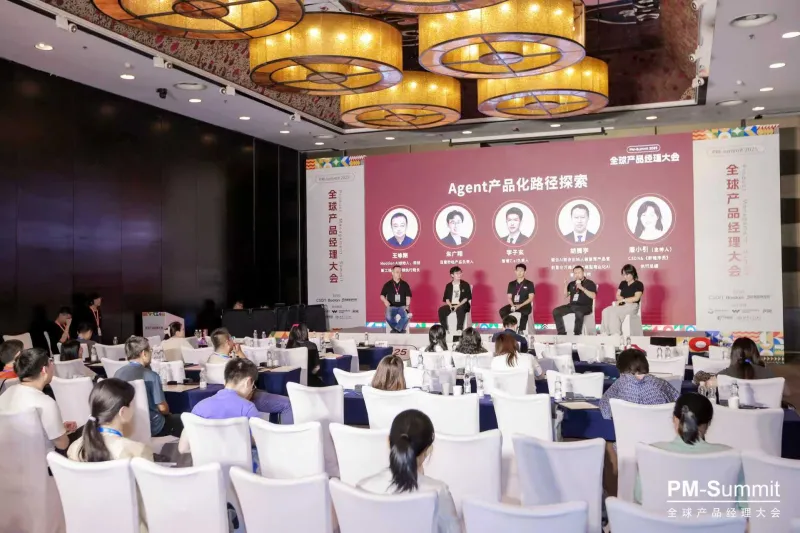
On the afternoon of August 15, in the panel dialogue themed "Exploring Agent Productization Paths," Mr. Hu joined heavyweight guests including Wang Yonggang, founder of Mootion AI; Zhu Guangxiang, product lead of Baidu Miaoda; and Li Zixuan, head of Zhipu Z.ai, for an in-depth discussion on agent deployment, technical evolution and business models.
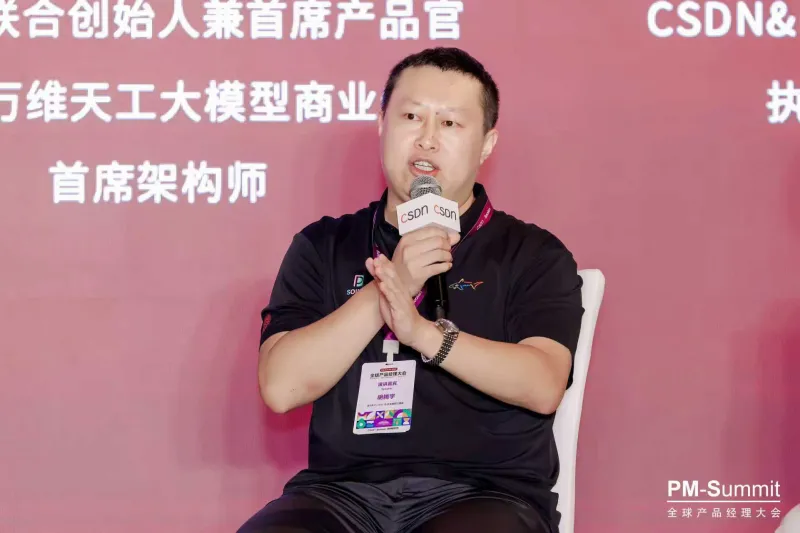
From the perspective of Agentic AI toB applications, Mr. Hu proposed three development stages of the agent productization path: from chat assistants to intelligent Q&A and then to intelligent decision support. He especially emphasized that in human-machine collaboration: "Software systems are designed for humans, while large models are designed to simulate human operations. In terms of deployment value, agents serve humans; but in terms of the deployment path, humans must teach the agent high-quality business data and business know-how, guide the agent, and let the agent iterate and optimize autonomously from feedback evaluations on real tasks."
On the capability requirements for product managers in the AI era, Mr. Hu gave professional advice: "Product managers must understand the market, the industry, customers, users, technology and operations — one of the most well-rounded roles. What doesn't change is the ability to insight into demand pain points. What changes in the AI era is the need to keep up with AI technology trends. Large models are a definite productive force; technology progress generates demand. AI technology iterates extremely fast, so product managers must be good at following AI industry trends and comprehensively learning the characteristics of various AI technologies to truly excel in the AI era."
Keynote: Agentic AI Reshapes Industry Application Practice
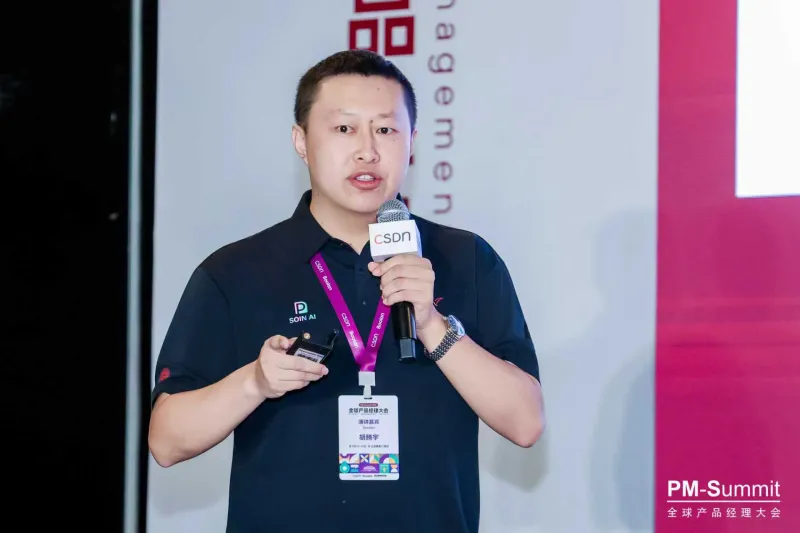
On August 16, Mr. Hu delivered the keynote "Agentic AI toB Deployment Practice — Agent Evolution from Education Publishing to Manufacturing." He systematically explained the three core elements of SOIN AI's Agentic AI toB deployment:
First, activate the enterprise's dormant data — unifying and integrating data scattered across enterprise systems to maximize data value;
Second, convert business rules and internal standards into agent knowledge and skills, letting AI truly understand and master the enterprise's core business logic;
Third, let the agent evolve autonomously — based on user feedback data from real work, using reinforcement learning to make AI understand the business and become a skilled worker.
Mr. Hu highlighted how SOIN AI's exploration of Agentic AI applications has solved five core pain points of enterprise digital transformation: unreadable data, unintelligent decisions, non-closed-loop experience, hard-to-quantify ROI, and incompatible ecosystems.
AI-native R&D teams: from traditional division of labor to capability fusion
On team collaboration transformation, Mr. Hu shared SOIN AI's innovative practice: "From functional division to capability fusion: product, algorithm and operations jointly build agents. 80% of SOIN AI's requirement documents are AI-generated, and PMs have all transformed into agent architects; 80% of R&D coding is written by AI, with each developer leading multiple AI engineers. A 3-person team delivered a PLM agent for a manufacturing customer in 3 weeks, while the traditional model would need 10 person-months."
Full-Chain Intelligent Upgrading of Manufacturing PLM in Practice
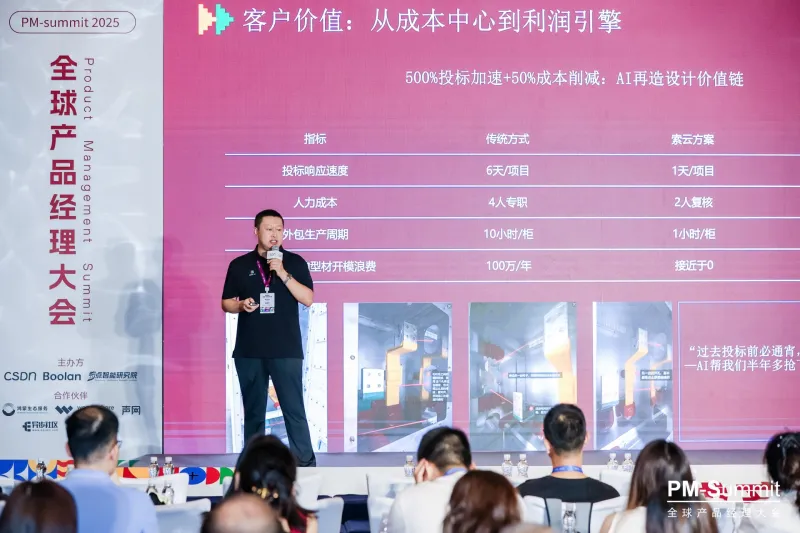
Mr. Hu deeply shared SOIN AI's benchmark case of full-chain intelligent upgrading of manufacturing PLM. As an AI ecosystem partner of PTC Windchill, SOIN AI has developed intelligent component data parsing and component material selection agents, achieving significant business value gains:
Component entry speed improved dozens of times, greatly accelerating product NPI
Substantially higher data entry accuracy, effectively reducing error risk
Significantly improved data search efficiency, accelerating R&D processes
Converting internal enterprise documents into AI-usable knowledge, transforming unstructured data into structured — modeling efficiency up 80%
Natural-language queries to business objects — query speed up 75%
Intelligent analysis and decision support — 40% reduction in engineering error risk
In the electrical industry, SOIN AI's intelligent drawing factory solution achieves AI minute-level parsing of CAD/PDF drawings with automatic BOM and quotation generation, delivering 500% bid acceleration and 50% cost reduction — truly re-creating the design value chain with AI.
The AWE Engine: Building Technical Barriers and a Commercial Moat
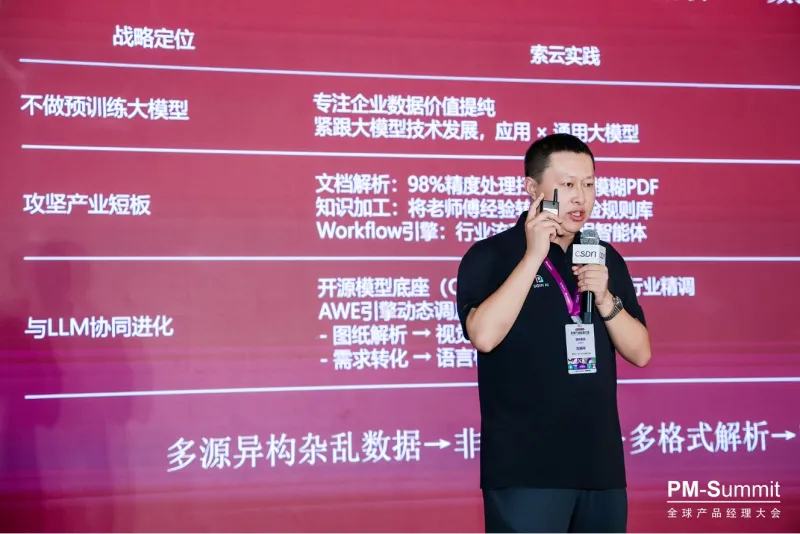
Mr. Hu highlighted SOIN AI's core technical advantages, clearly stating the technical route of "not building hundred-billion-parameter large models, but specializing in enterprise data alchemy." SOIN AI's technical barriers are reflected in:
AI application technical moat = non-intrusive collection × multi-format parsing × data-to-knowledge pipeline = solidified industry know-how
Specifically: non-intrusive collection (accuracy >98%) × multi-format parsing × vectorized storage = solidified industry know-how; the AWE engine dynamically schedules open-source models (Qwen/DeepSeek), compensating for LLM's industry shortcomings.
On the commercial path, SOIN AI adopts a three-step strategy: single-scenario entry → process connectivity → platform-based output. At the same time it actively builds an industry partner ecosystem: establishing ecosystem cooperation with traditional leading software companies to achieve deep fusion of traditional industries + AI.