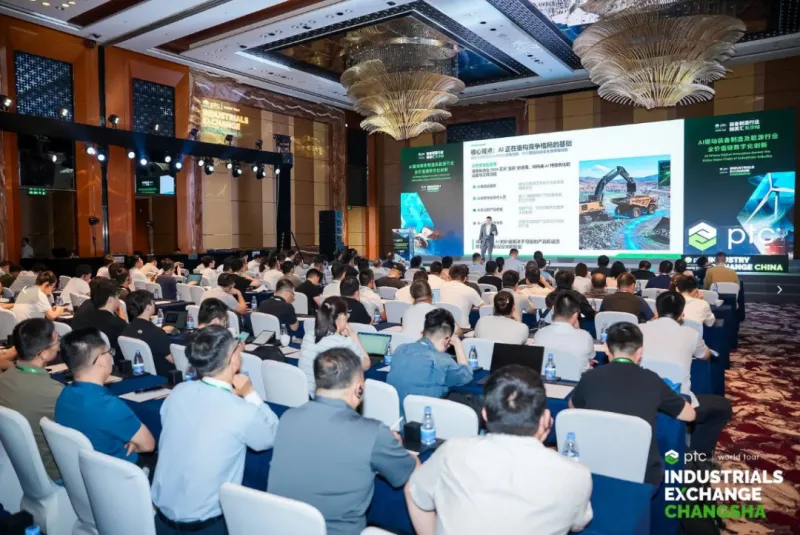
The PTC China Equipment Manufacturing Industry Elite Summit in Changsha
Today, artificial intelligence is moving from general-purpose Q&A and content generation into a new stage of deep integration with core business processes. For industries such as equipment manufacturing, energy, high-end equipment and new energy, the value of AI no longer lies in "demos you can see," but in whether it can enter key processes such as product R&D, requirements engineering, PLM data management, software lifecycle management, supply chain collaboration and service operations, and truly solve practical problems such as long development cycles, complex engineering data, high cross-team collaboration costs, hard-to-trace change impacts, and heavy testing and validation pressure.
On June 17, 2026, the PTC China Equipment Manufacturing Industry Elite Summit was successfully held in Changsha. Themed "AI-Driven Full-Value-Chain Digital Innovation for the Equipment Manufacturing and Energy Industries," the event brought together PTC global executives, local technical experts, industry ecosystem partners, and digital transformation leaders from construction machinery, wind power and energy, high-end equipment and other fields to explore the path to scaled adoption of industrial AI in equipment manufacturing and energy.
As a representative of AI implementation practice among PTC ecosystem partners, SOIN AI was invited to attend the event. Around core manufacturing scenarios such as "AI-Enhanced Product Requirements Engineering," "Windchill + AI" and "Codebeamer + AI," SOIN AI systematically presented its productized capabilities in Agentic AI, industry domain models, engineering knowledge processing, requirements governance, test generation, intelligent product data interaction, and localized AI deployment.
This marked another appearance by SOIN AI on the PTC ecosystem exchange platform, following the PTC China Digital Transformation Elite Summit in Xiamen, the PTC China Industry Elite Summit in Wuhan, and the PTC Automotive Industry Elite Summit in Qingdao, showcasing AI application capabilities oriented toward real manufacturing business scenarios. At previous PTC events, SOIN AI has repeatedly emphasized that manufacturing AI adoption must start from business pain points, combine enterprise data, processes and vertical model capabilities, and progressively develop AI agents that can be autonomously orchestrated and applied within core business processes, rather than remaining at the level of isolated tools or one-off demos.
PTC's Intelligent Product Lifecycle Strategy: AI Is Entering the Manufacturing Digital Thread
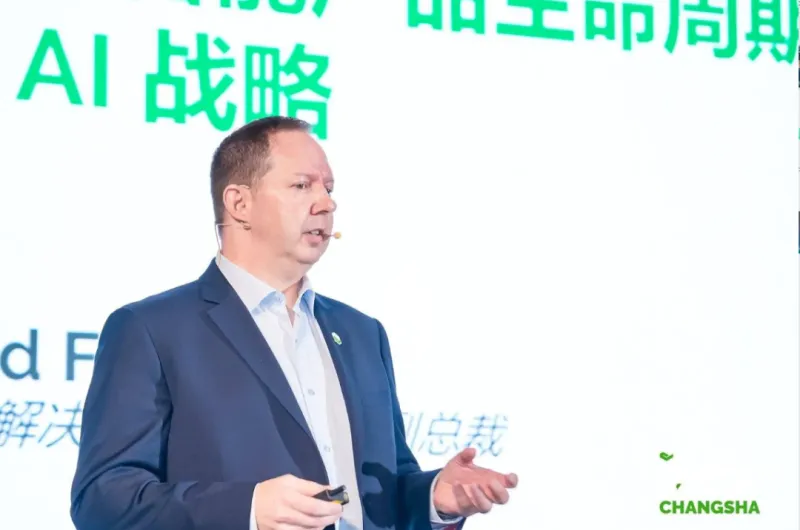
Mr. Brad Ferguson, Senior Vice President of Global Solution Consulting at PTC
At the event, PTC shared its intelligent product lifecycle framework, AI strategy and product roadmap. PTC argued that as manufacturing becomes increasingly intelligent, software-defined and service-oriented, enterprises need to build on trusted product data and embed AI into the tools and workflows engineers use every day, thereby releasing more value across the entire product lifecycle. PTC's official AI strategy also makes clear that its enterprise AI is built on a foundation of trusted product data and embedded in customers' everyday tools and workflows to support more efficient product innovation, decision-making and collaboration.
Within PTC's product portfolio, Windchill AI is embedding generative and agentic AI into PLM processes to help enterprises automate workflows, uncover product data insights, and boost productivity, while Codebeamer AI embeds generative AI into ALM to support requirements processing, quality improvement, and accelerated product development. This direction is highly consistent with SOIN AI's long-standing product philosophy: AI should enter the main process, not appear as a new isolated assistant.
The complexity of the equipment manufacturing and energy industries dictates that for AI to create long-term value, it must understand engineering semantics, process relationships, permission boundaries and data context. Objects such as requirements, BOMs, changes, tests, quality, supply chain and operations are linked by extensive upstream and downstream relationships; a misunderstanding at any single link can amplify into high rework costs at later design, validation, delivery and audit stages. Therefore, AI capabilities truly suited to manufacturing should not merely "answer questions," but should execute tasks around specific engineering objects, organize context, produce structured results, and write back into the enterprise digital thread after human confirmation.
AI-Enhanced Product Requirements Engineering: From "AI That Answers Questions" to "Agentic AI That Enters the R&D Process"
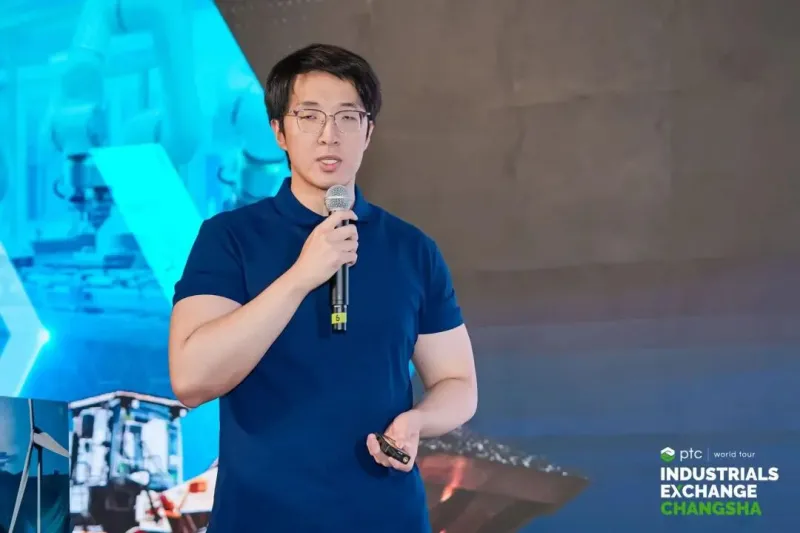
A presentation by Mr. Wang Xienan, Generative AI Application Expert at Sointech
In the "AI-Enhanced Product Requirements Engineering" session, Mr. Liu Hongxun, Presales Technical Consultant at PTC China, and Mr. Wang Xienan, Generative AI Application Expert at Sointech, discussed the transformation of requirements engineering under the software-defined product trend. Facing problems common to complex equipment enterprises — long requirements chains, parameter-intensive content, complex cross-team collaboration, and hard-to-trace requirement changes — the two speakers demonstrated how AI combines with requirements management platforms such as Codebeamer to form end-to-end intelligent augmentation spanning requirement import, quality checks, consistency verification, intelligent decomposition, and test case generation.
In its presentation, SOIN AI argued that requirements engineering in the complex equipment industry demands not just text understanding, but reliable judgment over terminology, parameters, rules and relationships. General-purpose models can handle natural-language understanding, summarization and generation, but in complex scenarios involving hydraulics, electronic control, control strategies, energy storage safety, engineering parameter boundaries, enterprise rules and upstream/downstream relationships, enterprises need industry domain models combined with context engineering to move AI from "reading the words" to "understanding the engineering constraints." This view was also reflected in SOIN AI's on-site materials: the key to a requirements engineering Agent is better context engineering — only by combining requirement sources, relationships, rules, history, tests and permission boundaries can AI results become engineering-usable.
Toward this goal, SOIN AI has embedded its ALA capabilities into the Codebeamer requirements management main process, forming a closed loop of "read requirements and relationship chains by requirement ID — AI-assisted processing — output structured results — human confirmation — write back into the Codebeamer main thread." This path emphasizes that AI does not replace the engineer's final judgment; instead, it provides confirmable, traceable, write-back engineering assistance in high-frequency actions such as reading, checking, retrieval, decomposition and validation.
SOIN AI ALA: Productized AI for Software Lifecycle Management in Advanced Manufacturing
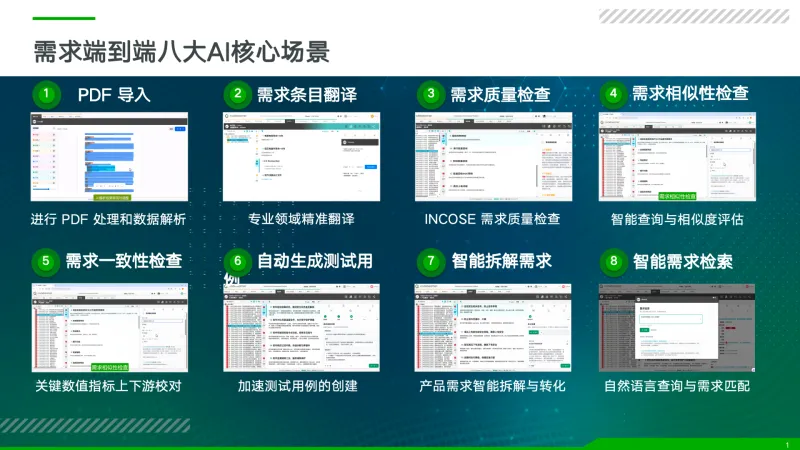
A demonstration of SOIN AI ALA capabilities embedded in Codebeamer
ALA (Autonomous Lifecycle Assistant), highlighted by SOIN AI at this event, is an industry-grade ALM intelligent application built on SOIN AI's proprietary Agentic Workflow Engine (AWE) and Agentic Documents Suite (ADS). Targeting high-value manufacturing activities such as requirements review, test management and component selection, it converts knowledge scattered across PDFs, technical specifications, requirement documents, test assets, historical projects and expert experience into orchestratable, callable knowledge assets that agents can execute automatically. Product materials show that ALA targets manufacturing ALM scenarios, focusing on requirements review, test management and component selection, and supports compliance and traceability requirements such as INCOSE, ISO 26262 and ASPICE.
Around the Codebeamer + AI scenario, SOIN AI has accumulated eight core end-to-end AI capabilities for requirements:
PDF import and requirement document parsing. For unstructured documents issued by OEMs — PDF specifications, agreements, change notices and more — ALA can automatically convert them into requirement documents that are clearly structured, properly formatted, editable and reusable, reducing manual entry and formatting work and improving requirement digestion efficiency from the start of a project. Requirement item translation and cross-language collaboration. For cross-regional R&D, overseas customer collaboration, and understanding of foreign-language technical standards, ALA provides precise domain-specific translation. Combining terminology bases, contextual semantics and industry expression conventions, it produces translations with consistent terminology, fluent logic and interactive quality, reducing misunderstanding of technical details among non-native teams.
Requirements quality checking. Requirement quality is the source of the R&D digital thread. Based on requirements quality standards such as INCOSE, ALA intelligently reviews requirement items for clarity, completeness, verifiability and consistency, helping enterprises catch potential ambiguity, omissions and non-standard wording before requirements enter design, development and validation, reducing the rework risk of late-stage defects.
Requirements similarity checking and knowledge reuse. In complex R&D environments with multiple teams and parallel projects, duplicated requirements, inconsistent wording and insufficient reuse of historical assets are common problems. Through semantic retrieval and similarity assessment, ALA identifies similar requirements, duplicates and potential contradictions, supporting cross-project reuse, requirements traceability and change impact analysis, improving the quality of the requirements repository and review efficiency.
Requirements consistency checking. In the equipment manufacturing, new energy and high-end equipment industries, key parameters in requirement items often have upstream/downstream decomposition relationships. Once value boundaries are distorted in transmission, downstream interfaces, system integration, testing and validation can all deviate. ALA automatically verifies the consistency of key numeric indicators across hierarchical requirements, identifies conflicts and supports jumping to related requirements, helping enterprises ensure that parameters are transmitted accurately, allocated sensibly and remain traceable.
Automated test case generation. Manual test case writing is time-consuming, coverage depends on experience, and steps and expected results are hard to standardize. ALA can run a test case generation process based on requirement content, producing test titles, preconditions, execution steps and expected results, and supports engineer correction and confirmation at any stage, so validation assets are deposited back into the ALM main thread.
AI-powered requirement decomposition. When product requirements become software requirements, and system requirements become subsystem requirements, ALA can perform structured decomposition in light of target business context and constraints, producing reviewable, traceable and more consistently granular software or downstream requirements, reducing omissions and ambiguity from manual interpretation.
Intelligent requirements retrieval. Keyword search across massive requirements repositories is inefficient and poorly suited to engineering semantics and parameter constraints. ALA supports natural-language querying and requirement matching, returning relevant requirement lists ranked by similarity and relevance, helping engineers quickly locate historical assets and supporting cross-project reuse, impact analysis and R&D decisions. PTC's official Codebeamer AI is also strengthening capabilities such as requirements authoring, test generation, traceability maintenance and compliance risk insight. According to PTC materials, Codebeamer AI can assist in generating, optimizing and clarifying requirements, propose test cases based on requirements, maintain accurate relationships between artifacts, and identify gaps, inconsistencies and compliance risks across the lifecycle early. SOIN AI's localized ALA capabilities go further, providing enhancements tailored to the real business practices of Chinese manufacturers, private deployment requirements, domain terminology systems, and existing platform integration environments.
Windchill + AI: Taking Product Data from "Manageable" to "Understandable, Reusable and Decision-Ready"
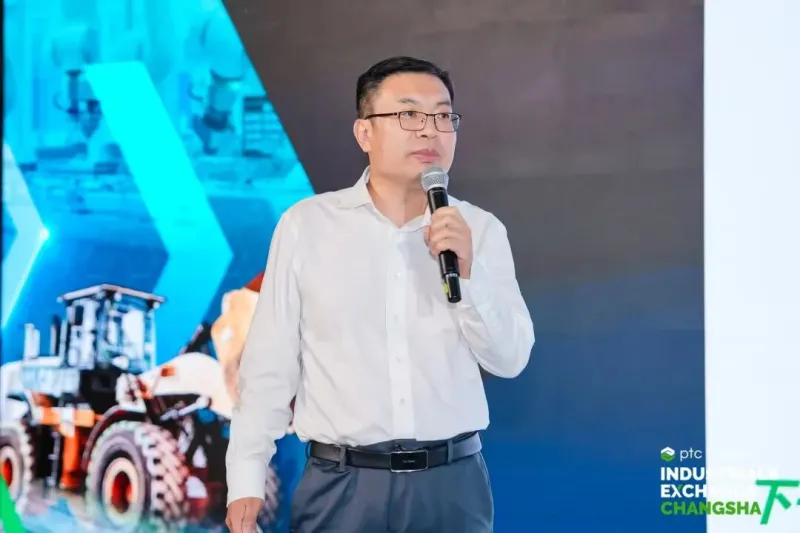
Mr. Lü Zhenyuan, Senior Technical Manager for Industrial Equipment at PTC, shares Windchill's localized AI strategy and cases
At this event, PTC also shared its localized Windchill AI strategy and cases, demonstrating the value of AI in product data interaction, business execution efficiency, and intelligent process collaboration. According to official PTC materials, Windchill AI embeds AI directly into PLM workflows, helping users find, understand and process complex product data faster; it supports natural-language queries, complex document summarization and trusted product data provenance, and improves PLM usage efficiency under strict access control and governance mechanisms.
Around the Windchill + AI scenario, SOIN AI has built multiple deployable capabilities within its manufacturing product and service system, concentrated in intelligent product data interaction, component technical document parsing, material query and selection, BOM data governance, change impact analysis, and knowledge graph augmentation.
In PLM-integrated supply chain and component management scenarios, common enterprise challenges include inefficient data entry, difficult data retrieval, and rigid analysis processes. Manual entry of material parameters is slow and error-prone and undermines selection and BOM accuracy; converting vague requirements into technical parameters is time-consuming for engineers, and semantic matching and data integration across multilingual documents are also difficult; traditional analysis processes rely on fixed rules and struggle to support flexible, multidimensional, cross-source decision support. SOIN AI's materials map these problems to three initiatives — intelligent data entry, intelligent query and intelligent analysis — including automatic material classification and attribute extraction, Datasheet data recognition and component knowledge base construction, duplicate detection and alternative recommendations, cross-project parameter reuse, multi-source comparative analysis, and first-draft technical solution generation. In component technical document parsing, SOIN AI supports multi-format document parsing and extraction, multilingual recognition and conversion, intelligent component classification, classification attribute extraction, and automatic creation of classified materials, helping enterprises convert unstructured information scattered across PDFs, Datasheets and supplier specifications into structured data assets, improving material data quality at the source.
For intelligent interaction and decision support, SOIN AI supports natural-language interactive queries, multi-source data integration and analysis, comprehensive component and material comparison, intelligent alternative material recommendations, and optimized design suggestions, helping engineers spend less time searching, comparing and organizing information in systems and more energy on design judgment and engineering decisions. In more complex PLM business processes, SOIN AI can also combine knowledge graphs, RAG retrieval augmentation and Agentic Workflow capabilities to support scenarios such as AI-assisted material query and selection, AI-assisted design change impact analysis, control plan assisted generation, and intelligent BOM assembly. The goal is not to bypass PLM main systems such as Windchill, but to build on the existing product data foundation and process system, letting AI perform information extraction, relationship understanding, risk alerts and structured output under trusted data, permission governance and human confirmation mechanisms.
From Single-Point AI Features to Process-Level Agents: SOIN AI's Methodology for Manufacturing Adoption
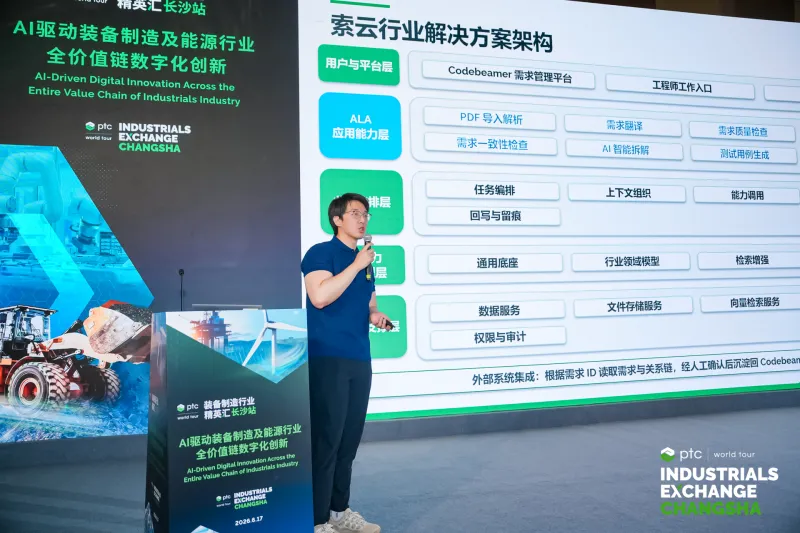
SOIN AI's industry solution architecture presentation
The difficulty of AI adoption in manufacturing has never been model capability alone, but how models combine with real enterprise processes, real data, real permissions and real accountability mechanisms. SOIN AI believes advanced manufacturers need a complete closed loop of "AI capabilities + business orchestration + data governance + human confirmation + system write-back."
In product architecture, SOIN AI has built its capability foundation around AWE and ADS. AWE provides multi-agent, multi-tool scheduling and task orchestration; ADS provides parsing, chunking, understanding, extraction and structured processing for complex documents. On this foundation, through Agentic RAG, multimodal chunking, semantic hierarchical embedding, high-precision requirement entity extraction and cross-document logic verification, SOIN AI converts complex manufacturing documents, rules, requirements, tests, materials and historical project experience into retrievable, judgeable, orchestratable and reusable engineering knowledge. Materials show that ALA has formed an ALM industry agent system including a requirements quality review Agent, test case generation and evaluation Agent, change impact analysis Agent, traceability matrix generation Agent and quality optimization suggestion Agent, with industrial-grade controllability requirements such as local deployment, private embedding models, document security isolation and traceable reasoning chains.
On deployment and governance, SOIN AI recommends that enterprises start from low-risk, high-frequency, must-have scenarios and progressively move toward operationalized requirements engineering: Phase 1 prioritizes materials and quality, making documents readable, translations consistent and requirements quality front-loaded; Phase 2 strengthens knowledge reuse and relationship verification, using similarity retrieval, historical reuse and upstream/downstream consistency checks to reduce duplication and conflicts; Phase 3 connects decomposition and validation, depositing requirement decomposition, test generation and validation assets into the main process; Phase 4 continuously optimizes domain models, turning expert corrections, false positives/negatives and human confirmation results into training and evaluation samples; Phase 5 establishes governance and continuous operations covering permissions, auditing, monitoring, evaluation and version management, ultimately achieving less rework, fewer omissions, less duplication and full traceability.
This methodology echoes PTC's assessment of embedded AI maturity. PTC divides the role of AI agents in enterprises into three maturity stages: "advise, assist, automate" — from immediate knowledge access, content summarization and related-information retrieval, to helping complete workflow steps, to autonomously connecting systems, monitoring data and driving outcomes with minimal human input. For manufacturers, AI adoption is not a one-step replacement of existing processes, but a gradual path from advisory suggestions to process collaboration, and then to automated execution in specific tasks, on the foundation of trusted data and process governance.
Deepening Engagement in the PTC Ecosystem: Moving Manufacturing AI from "Proof of Concept" to "Engineering Results"
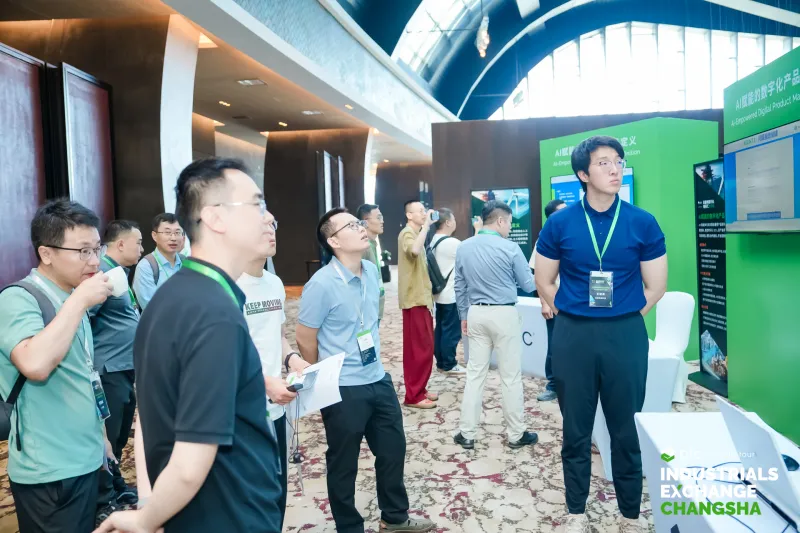
AI-Enabled Software Lifecycle Management at the Exhibition Booth
In recent years, SOIN AI has continuously explored PLM, ALM and manufacturing digitalization scenarios within the PTC ecosystem. In April 2026, SOIN AI launched the ALA software lifecycle management AI product solution at the PTC China Electronics and Medical Devices Industry Elite Summit in Wuhan, highlighting its capabilities in requirement document parsing, cross-language processing, requirements quality checking, requirements similarity identification and requirements consistency analysis, and clearly stating that AI should move beyond "recognizing content" or "answering questions" toward deeper support for requirements governance, knowledge reuse, collaborative processes and quality control.
In September 2025, at the PTC Automotive Industry Elite Summit in Qingdao, SOIN AI shared hands-on experience with Agentic AI in the automotive industry, proposing to address enterprise transformation pain points of "sleeping data, rigid processes and lack of evolution" through multimodal knowledge base construction, deep integration of Agentic AI with PLM systems, and combination of Agentic AI with ALM. From electronics and medical devices to automotive and then to equipment manufacturing and energy, SOIN AI's sustained participation in the PTC ecosystem reflects a continuous path from industry exchange and scenario validation to productized accumulation.
The Changsha event provided an important opportunity for SOIN AI to further showcase its manufacturing AI product capabilities. Around Codebeamer + AI, SOIN AI has built an end-to-end capability chain from requirement collection, analysis, decomposition and implementation to validation; around Windchill + AI, SOIN AI is integrating intelligent document parsing, material knowledge construction, BOM data governance, natural-language interaction, change impact analysis and knowledge graph augmentation into product data management and PLM business collaboration.
Looking ahead, SOIN AI will continue to uphold the philosophy of "AI applications — implementation is king," relying on its proprietary Agentic AI capabilities, manufacturing domain models and enterprise deployment experience, and work with PTC ecosystem partners and more equipment manufacturing, energy, high-end equipment and new energy enterprises to explore deep AI applications in R&D digitalization, product lifecycle management, software lifecycle management and supply chain collaboration.
AI is not an "add-on tool" for manufacturing digital transformation; it is an endogenous capability entering product data, engineering processes and enterprise knowledge systems. Through solid product accumulation and deployable solutions, SOIN AI aims to help manufacturers turn scattered data into reusable knowledge, turn complex processes into orchestratable tasks, and truly convert AI capabilities into higher-quality, more efficient, more traceable engineering results.